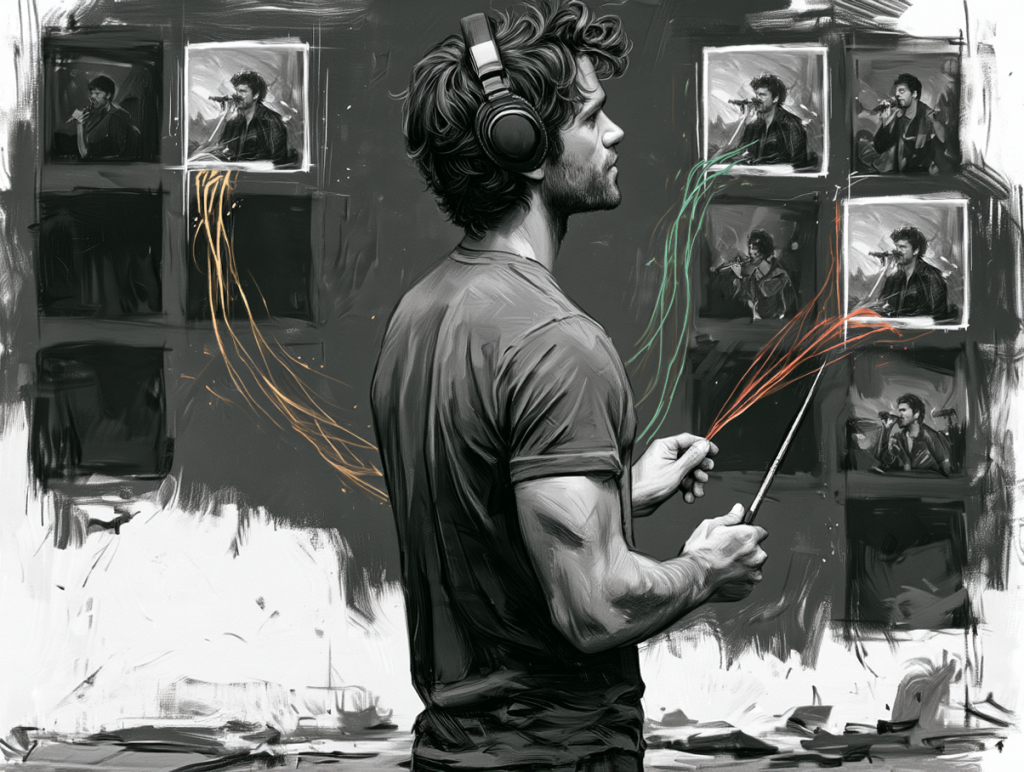
[Jared Halley is an a cappella artist. He builds an entire song by himself, every vocal part and all the percussion, each part recorded separately. On November 6, 2026, Jared granted me an hour interview. This is one of several posts drawn from that conversation.]
The songs are covers, other people’s music remade in his own voice. He calls the format the grid. On screen it is a wall of squares, each one a tight shot of a microphone with just enough room around it for him. The kick drum in one. A baritone line in another. The lead usually near the middle. He steps into a square when that layer is his to sing and steps out when it is done, and what is left is an empty studio. He breaks the song down by ear. The grid separates the layers to the eye and recombines them in the ear.
“There’s 16 plus parts in an average arrangement that I do.” Every square in the grid is a separate take. A simple or shorter song runs forty to sixty hours. A complex one is “at least 80 hours, if not more.”
I asked whether he gets anything to work from, or whether he just listens and figures out how to piece it back together.
“No. So everything that I replicate, I just hear it by ear.”
I asked whether he has to rewrite the sheet music.
“I don’t even rewrite it. I just do everything in my ear. So the recording software I showed you earlier, so I will just sing into the microphone what I hear and I’ll just mimic it as I’m listening. And so that’s what I do when I make the arrangement.”
Headphones on, original playing, singing what he hears straight into the software, one part at a time. So I asked how he documents an arrangement.
“When I do the arrangement, I don’t document it. I just record it.”
The recording is the score. And then, plainly:
“And so I don’t have any sheet music or anything like that for the ones that I’ve arranged.”
All I said was wow.
The only step he outsources is the arrangement, and he hires that out when a song is complicated. For the Queen medley he told an arranger which songs he wanted combined, and what came back was sheet music plus a listening track for every part, tenor one through three, baritone one through three, bass. I said wow again. He reads and listens at the same time, which he says helps him learn it faster. That is the one category of song where the music exists on paper, and it exists on paper because somebody else wrote it down.
For everything he arranges himself, he pulls it apart in a consistent order. He starts with whatever stands out most.
“The thing that sticks out the most to me. So usually that’s like the, either the piano chords, that’s a good place to start because then you have like the backbone of the arrangement.”
Usually a triad, three notes that run through the whole arrangement. Then the bass. Then the other non-percussion layers, the synths, which he keeps smooth and sets a little softer in the mix while the piano parts stay plucky. Together, he says, “it just makes everything more full.” Percussion comes last.
“I usually start with the kick and I’ll figure out where the kick is going. And then I’ll move on to the snare and the hi-hat and, you know, just mimic the entire drum kit or whatever percussion is for that song.”
In his covers, there is no drum kit. There is no piano and no bass guitar. Every part is him in a studio with no instruments in it, his voice standing in for the piano and the bass, body percussion for the kit.
So I asked whether those sounds have names.
“I mean, some of them I just kind of make up, but the main ones would be kick.”
Then he demonstrated. Kick, snare, an inward snare, shaker, one after another, a whole drum kit assembled out of a man standing in his studio.
“So they all have real names to something physical,” I said.
“Right. Yeah. So I’m basically mimicking a drum kit or a percussion section. And so I’ll just use those same names that I’m trying to mimic.”
The song goes in through his ear and comes back out of his body, and every name involved belongs to an instrument that was never there. In the arrangements he makes himself, nothing is transcribed. Nothing is notated. At no point does the music exist as writing.
Which raises the question of how a person stands in front of a camera and knows when to come in, sixteen times or more, as sixteen different parts.
He showed me, mid-interview. He still had the previous day’s filming setup running. A recording session open on the monitor in front of where he stands, every track labeled, and he scrolled down and read them off to me: lead, cymbals, tenor one through four, baritone one and two, bass, kick, snare, hi-hat.
“I’ve come to find that just following, as I practice, following like the waveforms and stuff like that, especially for like percussion, is how I stay in cue and on track.”
He watches the shape of the sound on the screen, and that is how he knows when to come in, every time, on every layer. He can also throw the lyrics up there if he is tripping over them.
If a song needs two identical parts, he does not copy the track. He records it again.
“I do it double because when you just copy paste it, it looks weird. So like if I have two recordings of the same part, I’ll record two unique videos. Because if you do two that are just copy paste, it looks too robotic to me.”
Not what it sounds like. What it looks like.
“I’ve tried it in the past and I went to do the edit and I was like, I don’t really like that. So I went back and recorded the individual parts because it just looks more real. Like less, I don’t know, I just didn’t like it, it wasn’t pleasing to my eyes.”
“Since I had already recorded the part, like I already knew it, it was already in my brain. And so I just re-recorded it real quick. It didn’t take me that much longer to re-record. And that doesn’t happen very often.”
So this is not a grand sacrifice of hours. It is smaller than that, and stranger. There is a version of the work that would be easier and would pass, and he has tried it, and he went back and did it over because of how it sat with him.
“But I still do a unique take for each of those tracks just so it looks more real. Like if I were to just copy paste one for like five of those squares, it wouldn’t look as good. At least not to me.”
“And so yes, it would take less time, but I don’t think it’s worth the time I’d save to have like in my mind a mediocre product.”
The whole song is built by ear, with nothing written down anywhere. And the one place he draws a hard line is a visual difference, in a grid of squares, that only he would ever catch.
Early in the hour he told me he enjoys pulling back the curtain a little bit, showing his process and answering questions when he can. He did, for an hour, on everything I asked.
Next: What happened when I made my own request for a cover.
Look for Jared…
Related Posts
He Wrote Back—the earlier post about Jared writing back after “Rescue Me.”