Journaling

  • Still I Stand: A New Confidence Naming

    Back in April, I wrote about confidence naming—the therapy thread where Tim described the idea of an activating phrase. He asked me to name my “confident stance.”

    The idea: if you can name the version of yourself who owns the room, you can step into that version when it matters. I wrote about several phrases I already use:

    • “head up chest out” from Kevin at the gym,
    • “working on it” from unfocused pool laps,
    • “push against the current” from the resistance pool,
    • “driving fast and taking chances” reclaimed for joy,
    • “I’m going” from yellow traffic lights that demand calling Dibs.

    The actual ask Tim made was for a universal phrase. Not several context-specific ones. A single verbal switch that could unlock the whole confident persona no matter the situation. I ended my April post by saying:

    “Which one, if any, is the universal? Still looking and deciding.”

    The discussion went dormant. Tim and I never brought confidence naming back up in session—the daily system he and I use for homework only allowed him to receive the abridged version of the post, not the full backstories.

    This week I think I found something important. It isn’t a phrase. It’s a song. Numerous lines that can be used as personalized phrases that help to invoke confidence. This week on Patreon, Jared Halley shared a sneak preview from his upcoming album of original songs. On a constant loop, I’ve been listening to “Still I Stand.”

    [Chorus]

    Still I stand
    On this broken ground
    Through the silence
    I found my sound
    No chains can hold
    No walls confine
    Still I stand
    This fight is mine

    Every song carries two backstories at once: the songwriter’s and the listener’s. Both live in the lyrics simultaneously. When a song like Still I Stand offers the perfect line, or lines, I find a new confidence naming. “This Fight is Mine” is just one, the best.

    The verses bring you up to speed on the heavy nights, dragging days, weight carried nowhere. The song paints depression without saying the word. Then a flicker: faint and small. Not blinding, not certain. Just a spark. The pre-chorus makes the deal explicit: echoes that fade, scars that stay, strength born from pain. There’s no “and then you’re healed” in this song. The scars stay. That’s part of why the song means so much to me.

    One thing songs do that life doesn’t: they compress time. In the lyric, two lines are one line apart

    Nowhere to go
    But I saw a flicker

    In life, the distance between those two states can be as much as months, or even years. The song delivers the arc in seconds; the actual passage from one to the other takes fortitude.


    When I listen to Still I Stand, I am not the singer. The person in the song has already lived through all or part of something and is ready to claim the fight, is right there, still standing.

    I’ve accomplished plenty. Yet my broken ground still shifts under my feet most days. I don’t know yet what sound might be mine. I can’t claim the no-chains part and have it be true right now. Only true someday, maybe.

    What I can do is borrow. I can play the song, and for the length of it, I can inhabit the stance the singer has reached. The confidence is ready in the music. But loaned, not owned. When the song ends, I go back to my regular self. (Or, I happily play it again.)

    Maybe the universal confidence naming doesn’t have to be just a phrase. A song can provide what is needed—press play, and the confidence is already there. I don’t have to force the feeling. The song brings it out.

    I have all my phrases. Head up chest out still works when I’m walking somewhere. Working on it still works when the pool of tasks is unfocused. But when I need the entire confident persona, I now have a place to go. The whole point of a confidence naming is that it’s a tool to use repeatedly. Not one and done.


    “This fight is mine” carries a lot for a four-word phrase.

    There’s a whole genre of movie moments where a character claims a fight and demands everyone else step back. LOTR: Aragorn stepping forward at the Black Gate; Frodo insisting on carrying the ring alone. Harry Potter vs. Voldemort: “Neither can live while the other survives.” Every boxing movie ever made—”let me handle this.” Every Western showdown. Braveheart, Gladiator.

    The pattern isn’t just about ownership. It’s about earning the right—or wanting the privilege of the hard thing. The hero doesn’t want to share it. Sidekicks want to help; the hero waves them off. Not because help isn’t wanted—because this one is mine to face.

    The hero, in that moment, is always the one—even when others are present. Being “alone” here isn’t about the number of people nearby; it’s about who has to face the thing. Sometimes chosen alone, sometimes forced. In the movies, that isolation is earned—the hero has demanded it. In life it can feel more like this is what I got left, so I claim it as mine. Same words, different origin story. Chosen alone and arrived at alone aren’t the same, but the song fits both.

    And not every fight fits this pattern. Some fights are the kind you claim with pride and stance and voice. Other fights—my future, my aging body, my relationship to time—those aren’t about fighting at all. Those are about accepting. And “this fight is mine” is the wrong language for those times. When the opponent is your own resistance to a reality that already is, the movie-hero framing doesn’t help. The work of acceptance is dissolving the resistance, not doubling down on it. Some fights only I can fight; some things I have to stop fighting.


    There’s another reading of the chorus I can’t unhear. The silence is the trigger—it means no one is here. And the freedom lines—no chains holding, no walls confining—read differently against that silence. This isn’t only liberation. When you’re alone—both bad and good—you’re in charge. No one holding you. No one sheltering you. The freedom and the isolation are the same fact. Finding my sound becomes about making progress through the chains and walls, not around them. And then still standing—this fight mine, as in nobody else’s, nobody helping.

    I keep having to do so much alone. Depression is one of those walls. So are the voices—sometimes actual people, sometimes only my own head. Same internal walls either way. They need no help from external ones.


    There’s a difference between “I hate this” and “this fight is mine.” Both are honest responses to hardship. One is protest—legitimate. One is claiming—also legitimate. One doesn’t replace the other, and pretending you can always be in the second one would be dishonest. You can’t give the same fight all the time. It’s easy to stand on the hill or enjoy the broken ground when mood or life lets you be full of courage. On the days those resources aren’t there, “I hate this” is the true answer.

    On the in-between days there’s something smaller. Not fighting the fight well. Not winning. Just refusing to hand it off. Standing up when I’d rather stay down. Playing the song.

    The song sings the fully-claimed version. My job on any given day is whatever version I can muster. And the standing isn’t a one-time thing.


    Still I stand.

    This fight is mine.

    Both have been added to the collection of confidence naming.


    Look for Jared…


    Related Posts

    Background Stories About Confidence Naming—the April post, with the full origin stories for each of the phrases mentioned above.

    He Wrote Back—the earlier post about Jared writing back after “Rescue Me.”

  • Broke the Seal

    I had brought a 12 oz. bottle of water. Klarbrunn.

    It seems like lately, all sorts of different lids do not twist off easily anymore, and I was once the kind of person that people went to to get lids taken off. I was so strong. Now, I struggle. I was about to struggle to open my water.

    Out of the blue, I realized, “I don’t need to sit here and be embarrassed and struggle and look like an idiot.” I just said one word: “Help,” as I handed my bottle to Tim. He accepted the bottle, and with one twist, he broke the seal for me, and handed the bottle back to me. Problem solved.

    And I don’t know why. Suddenly, this little tiny gesture is like a whole microcosm of being in therapy: I hand him my bottle, he opens it, and now I can drink from it.

    Everyone should drink more water.

    Now that I just said that, this sounds totally even worse and ridiculous than wanting to put the moment into the gratitude record. Anyway, whatever, let’s definitely mark a gratitude that Tim opened my water bottle.

    And maybe what I liked the best about it was that I only had to say one word, and the rest of it was just an unspoken exchange back and forth. Complete. Does a single word followed by exact actions qualify as “forthright communication”? Thinking back on the moment, the emotions make me want to cry. Yeah. No tears, no watered eyes, but if I thought about it just the right way, I could get some tears to drop.

    Six more gratitudes happened that same hour. I recorded all of them. Only one repeat.

  • NEXT

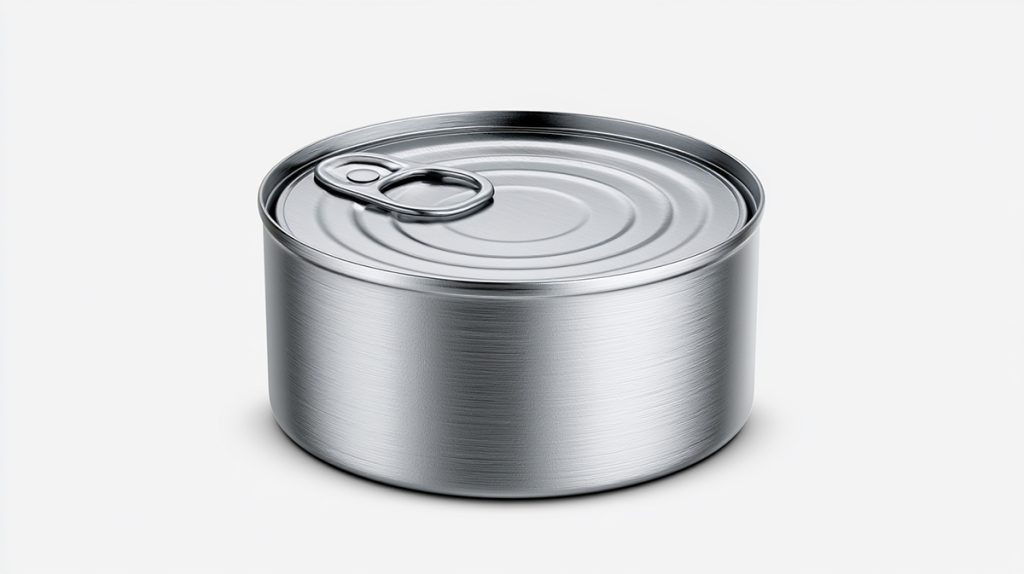
    Not that communication with Philip, nor finances, nor sleep, nor reasonable dog… are done. What is next is anxiety. Fingernail biting is so bad now, I can’t even open the pull top on cans of wet cat food for Max every morning. The temporary work-around is grabbing a spoon. Sure, that works, but really, that is not the solution. All anxiety can’t be canceled with one easy fix. But maybe there is 1.1 fix toward one awkward result of anxiety. I notice other people’s hands and nails. I’m sure mine stand out as bad to others.

    I don’t want the spoon to be the long-term fix.

    The right fix involves noticing. But noticing requires noticing. How do you teach yourself to notice the movement of the hand toward the danger?

    OHHHHH. I know I’m going to hear this super simple instruction that sounds simple but isn’t actually in the moment. There isn’t one. The body of anxiety just finds somewhere else to attack.

  • Chase—Part 4: My Original ESA

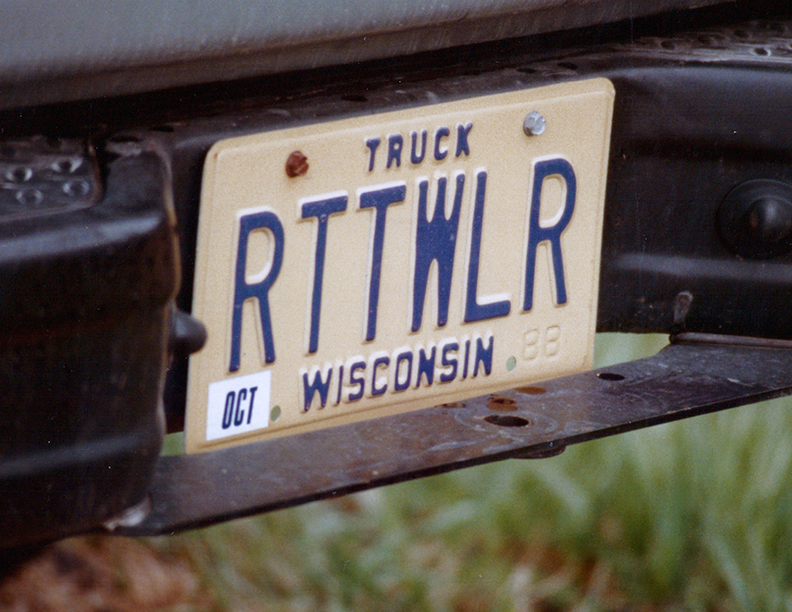
    1988 Wisconsin license plate

    Chase was a companion that stayed with me the longest. He died the summer of 1996.

    I branded my entire internet presence on my Rottweiler. Even before the internet handles, I registered for a personalized Wisconsin license plate. 1987. RTTWLR. Used this abbreviation on eWorld and gmail. When I switched to a real Internet Service Provider, I asked for chase to be part of my email address. And is still today.

    Hindsight can lie. Yet, I believe I am sure that raising and training Chase kept me steady. The hours of training that earned us degrees and certificates also provided mental health. I was accused of loving my dog more than my son. Admittedly Chase was my first baby boy. I didn’t neglect Philip. He was included on purpose such that I didn’t leave him with sitters. Chase loved and protected Philip. At trials, Chase and I in the ring together, he always knew where Philip was situated.

    Chase was my first permanent photography model. I created multiple personal graphic design logos in his image. He inspired me to commit a crime: I stole a full-size wood road sign, Utility Work Ahead. In the midst of training for his UD, the impulse was greater than the risk.

    An ESA is emotional support. Chase was mine when he was the only body waiting for me in the truck outside the abortion clinic. He went with me on the 1000 mile road trip when I freaked out at work and ran away over a small issue.

    I have a habit of expecting people in my life to replace my dog. (Kevin. Brendan).

  • Chase—Part 3: The Radio Flyer Was Essential

    Rottweilers don’t know they are not lap dogs. Chase would back up to the couch and when his butt touched the cushions, he would keep backing up until his whole butt was sitting on the couch, front legs just standing there. He’d do the same on your lap..

    Chase didn’t eat the baby. Toddler Philip would crawl up to Chase and take rawhide bones from his mouth; Chase just looked forlorn and spoke with his eyes saying, “he took my bone.”

    One birthday I bought Rick a red toy remote control race car. Off leash, Chase would chase the car up the street, down the sidewalk, and turn circles in the driveway.

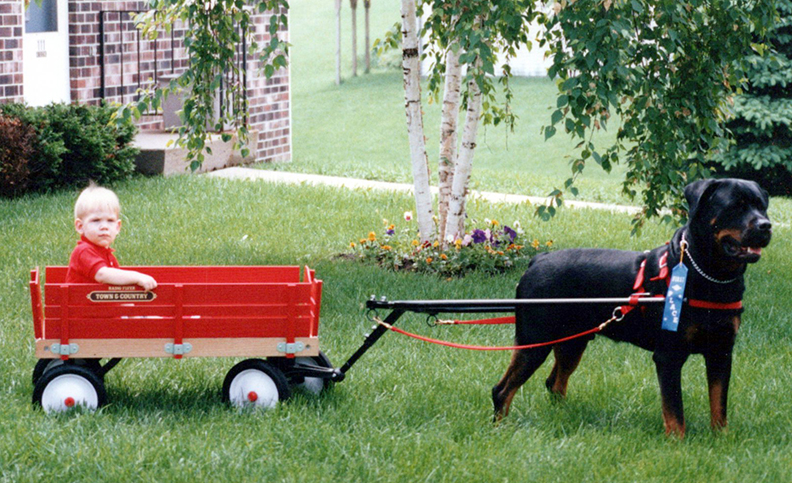
    There was the essential purchase of the Radio Flyer Town & Country wagon for Philip.

    At the BKC show, a vendor had the tongue to fit that wagon. I bought a RED carting harness. Chase trained easily—unleashed, go/stop-wait at crossings, called back for wide U-turns. We dressed the outfit like a chuck wagon with Philip in cowboy gear, or 4th of July flags..

    After the CDX, Chase learned every UD routine. but he hated the competition. Every time, every show, something different would get messed up. We stopped going. I knew he could do every part, but we found agility instead. He loved racing the obstacle course with me. And he thrived at carting, earning his certificate.

    Before and after Philip was born, Chase was my answer to social anxiety. People could talk to me about my dog and I was able to relax. Chase pulling Philip in the wagon was an awesome conversation starter.

  • Chase—Part 2: Philip’s first word was “Dog.”

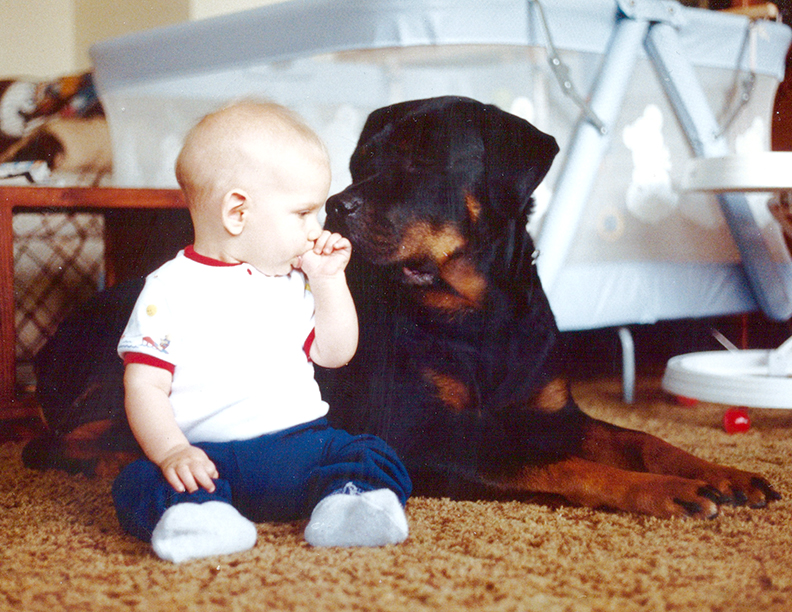
    Philip and Chase sitting together in the living room.

    The litter was born in July. Every week on Sunday I would hang out with the breeder and the puppies. I played with them and began to chronicle the life of Chase through photographs. On the Lee Valley Road farm he had room to grow. We started doing a weekly visit to the Badger Kennel Club, doggie school. Just sit on the sidelines for puppy socialization.

    Steven and I bought a new Ford Ranger with a topper. We added slider windows in the cab and topper and placed a boot to seal the passage. Once Chase reached the right height, he immediately learned to jump and scramble through. Chase went everywhere with me. When he was the proper age, we registered for obedience classes with Jo-El Kennel Club to receive the best instruction from Drew and Betsy.

    Within a year we traveled to Wisconsin, Illinois and Michigan to compete in obedience trials to earn his Companion Dog (CD) certificate. Once accomplished, onward to Companion Dog eXcellent (CDX) which included jumps.

    Life changes happened: our address moved, my relationships changed. But Chase was the constant.

    When I was pregnant with Philip, family and friends said to get rid of my dog because he’d eat the baby. Chase was mine to keep. Anyone who spent time with us would be convinced that his training was complete. Philip’s first word was “Dog.”

    Philip, Chase, and I went everywhere. We’d travel to dog shows. Sometime camping. Chase started working on his Utility Dog (UD) certificate. Then we added the activity he really loved.

  • Chase—Part 1: The name was four years older than the dog

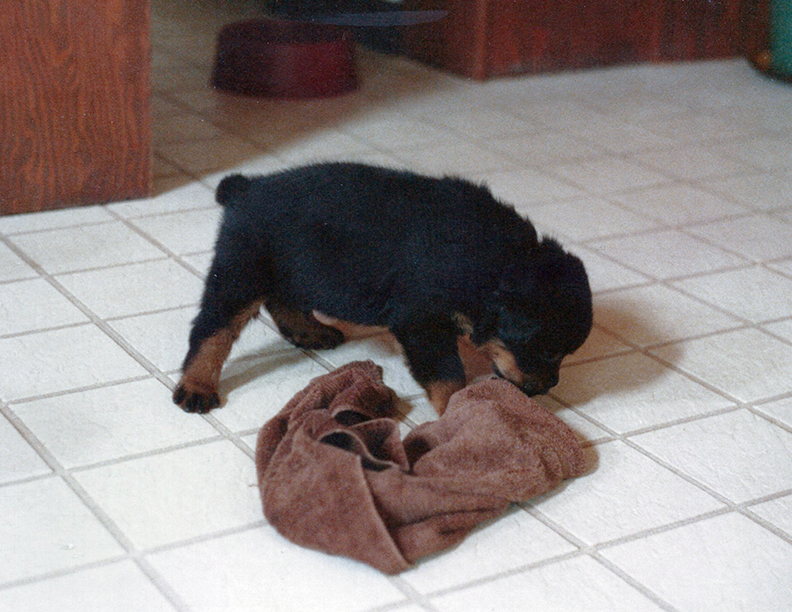
    Chase at 4 weeks.

    Origins

    The series of family moves [Silverton-Galt-Silverton] was a 3 step process of removing livestock and pets from life. By Corvallis, all gone. By Madison just a wish. About a month fresh to Wisconsin, our family house-camped in a temporary rental. I asked for a dog. I even picked Doberman because my mom favored Magnum PI. No dog. Then, Boxleitner in TV movie Bare Essence = Chase. The name was four years older than the dog. Three houses later, dog was my purview to make happen. Then, I witnessed/assisted in the surgery to crop a Doberman’s ears. Even as farm raised, I was horrified. No cropped ear breeds allowed at my hearth.

    I fell in love with the cover of the Rottweiler breed book on the wire rack at the vet clinic where I worked. The much better version of the same thing. Beefier. Working dog. Same coat. As soon as able, I would have my own puppy.

    Through a connection at church I found a breeder. Steven and I made a deposit. There was a false pregnancy and big disappointment. Then there was a litter, and I picked out my puppy. A brand new collar and leash. Red. His color for all equipment and accessories.

    Key Moments Through the Years

    • Lee Valley Rd. When the horse fence was being installed, a very young Chase stole the leather glove from the workman.
    • Loved the boot in the Ford Ranger, learned to jump and scramble through… and even as a full size Rotty could still wiggle through.
    • Brought Chase with me when I went for the interview to move in with Rick.

  • Big Dogs

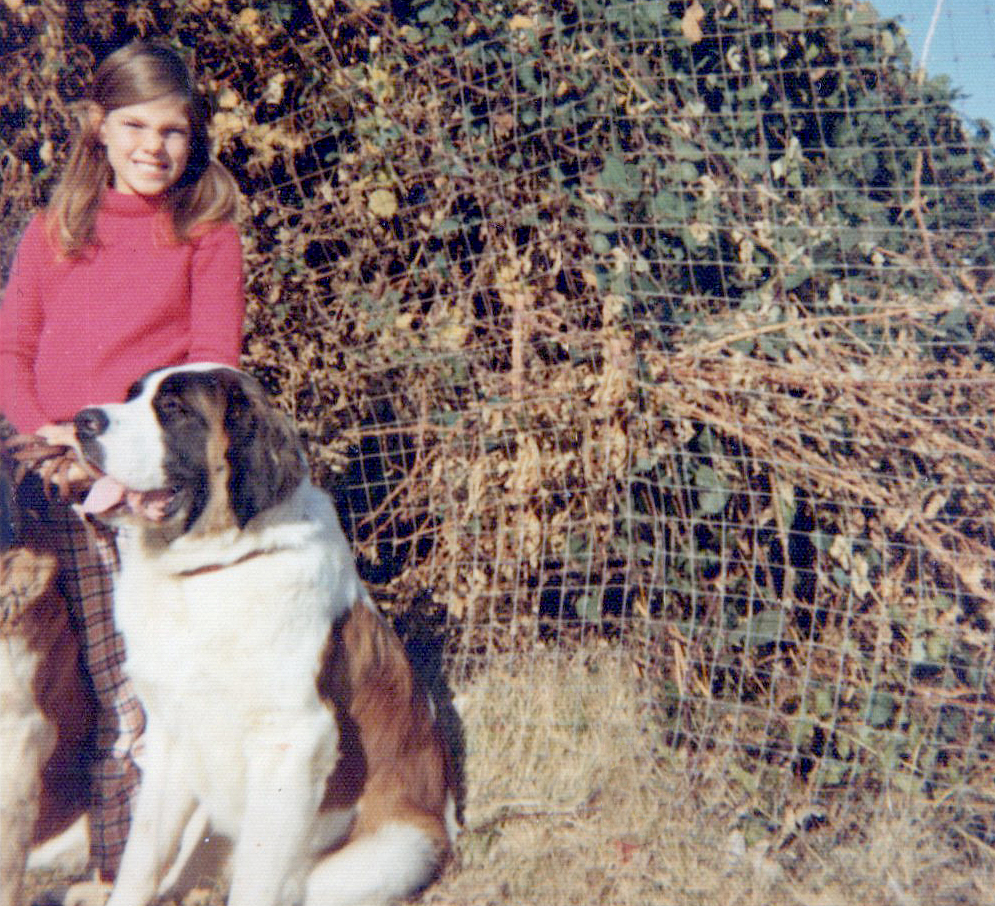
    Lena and Molly in 1971

    I’ve only had big dogs. St. Bernard’s as a kid and Rottweilers as an adult. Molly was a female splash Saint. Argo was a female mantle Saint. My brother, Bill, had a Blue Tick Heeler named JohnDog for a few months. Chase, male Rotty, was my first baby boy. Obedience, agility, carting, sledding, weight pulling. Tyler, female Rotty, was from a litter sired by Chase. I raised her for about a year and found her a good home. Shortly after Chase died at nine, I started fresh with a male puppy Rotty named August. Due to life, he needed to be rehomed at about two years old.
     
    On a trip to Iowa to visit Sharon: a tall metal slide at the park. I had trained Chase to climb the vertical ladder and run down the slide. I have a photo of him at the top, he waiting for my command to come down.
     
    So starting at the dream side of the equation. You know, just the fun fantasy place to venture. Flushing out. Mind to wander. Say it in my mind; say it out loud if I get the chance.

    What I know…

    • I don’t want to adopt Mister, Philip’s abandoned Pitbull in Blue Mounds.
    • Short hair.
    • Breeder, not adopted.
    • A chunky dog, sturdy built, huggable. Fast. Trainable.
    • Black and tan, a bonus, but not a requirement.
    • Train for agility again.
    • Might be fun to build my own agility equipment again.
    • Bernese Mountain Dogs are cool. Oh, wait, those are big.
    • No breed with smushed nose and face.
    • [DONE] A vehicle to ride together
  • Escape Four Months

    Gratitude has started to normalize for Escape. To prevent a loss, every financial pinch should be put up against how I feel about Escape or the thrill of how it all started. When I feel the pain of compromising or suffering from finance readjustment, think about Escape.

    How do you keep the music playing?
    How do you make it last?
    How do you keep the song from fading
    too fast?
    …
    I know the way I feel for you is now or never
    The more I love, the more that I’m afraid
    That in your eyes I may not see forever, forever

    If we can be the best of lovers
    Yet be the best of friends
    If we can try with every day to make it better as it grows
    With any luck than I suppose
    The music never ends

    [James Ingram and Patti Austin, “How Do You Keep the Music Playing”]

    The worry I am having about traffic accidents: what is that? I don’t think focusing on something positive is exactly right. Even though Tim said, “…the way to get rid of that thought is to put your focus on some other topic or thought. If you put your energy into that thought, that’s where your focus goes.” Instead, something about the fear should get incorporated in the replacement thoughts. Use the fear to pay the right amount of attention to not being sloppy or careless. But certainly not to get spiraling into the wrong type of thinking.

    Is Escape still my favorite thing? Yes and I want to be a good custodian to maintain the shiny warm gratitude; and the shiny ruby red coat.

  • Trajectory Recalculated

    Re: Question 1 from 06-19-2026 – Finances

    Yesterday, I called UW Credit Union and applied for a personal loan to consolidate my two credit cards (PayPal MC and BMO Mastercard). I got approved and picked up the cashier’s check.

    The Numbers

    • Combined card debt: ~$8,494
    • Loan: $8,000 at 13.2% APR, 48 months
    • New payment: $220.55/month (down from $328/month across both cards)
    • BMO will have ~$494 left after the payoff, which I’ll knock out over a couple months

    The Big Picture

    The PayPal card was sitting at a 30.24% interest rate—on a 17-year payoff trajectory at minimum payments. This consolidation gets everything done in 4 years at 13.2%. By making this move, I’ll pay roughly $2,600 in interest instead of $15,200—saving over $12,600.

    Once the check is deposited and both cards are paid off / paid down, it’s one payment, one loan, done in 4 years.

    Humor and Fear

    While chatting in my Claude project for my BCT, discussing the new loan, Claude recalculated the savings related interest. So Claude basically volunteered to check Claude’s math. Savings, good thing.

    Why am I still anxious and discouraged? Where is the flaw in my thinking that keeps this from being a positive act? My idea. The me that impulsively made the UWCU call must have thought it was a good idea.

    Maybe I need an easier question: are Cheetos Puffs good for breakfast?